.png?width=900&height=246&name=divvy-logo-blue-rgb-900px-w-72ppi%20(1).png "DivvyLaw")
The Quiet Quitting Isn't a Plan or an Acceptable Marriage – Part 2

In part one of this series, we discussed the trend found in many marriages called quiet quitting. This topic reached national awareness, raised by Monica Corcoran Harel in the November 2025 call “The Cut,” and amplified by Oprah, who dedicated a podcast episode to the topic.
Quiet quitting in a marriage is not a new behavior, but using this modern workplace term to describe emotional withdrawal is a recent trend. Couples have long lived like polite roommates or delayed divorce until children grew older, or until some life event forces them to act. In many cases, the woman is the one who has withdrawn from the marriage, and her suffering goes unnoticed by her spouse
In the first part of the blog series, we will discuss how quiet quitting comes about. In part two of this series, we will discuss why quiet quitting should not be an acceptable plan to continue what is otherwise a dead marriage.
The Silent Cost of Keeping the Peace
While many people might find a woman’s willingness to stay in a loveless marriage noble or stoic, the reality is there is a cost to pay. That cost might even be the woman’s life.
A study conducted in 2005 by the American Heart Association found that women who engaged in quiet quitting and avoided conflict with their spouses have an increased risk of dying from any cause. This was corroborated in a separate study conducted over a decade by Elaine Eaker and colleagues, who published the marital analysis in Psychosomatic Medicine in 2007. The study found that women who reported that they habitually kept their feelings to themselves during conflict with a spouse, a pattern researchers call self-silencing, were four times more likely to die during the follow-up period than women who spoke up. That held after adjusting for age, blood pressure, smoking, cholesterol, and body mass index.
These studies directly relate to the women who live the life of quiet quitting, as this describes their behavior exactly. Self-silencing is the operational method. Keep the peace, absorb the disappointment, don't start anything, get through the week. The body is apparently keeping a ledger the marriage isn't.
This is not simply being noble by choosing silence to keep the peace. What the research suggests is that it isn't peace. It's a sustained physiological effort to appear peaceful, which is a different activity entirely, and it doesn't get cheaper with practice.
The Economic Cost
Probably the most used argument for quiet quitting is the financial argument. Getting a divorce can be costly in both the process and the outcome. Hiring an attorney can cost tens of thousands of dollars. Instead of splitting assets, they simply enrich the attorneys who are fighting their cause.
The reality of living separately in California is another financial reality. When a couple can barely afford one residence with two incomes, how can they possibly survive having two homes?
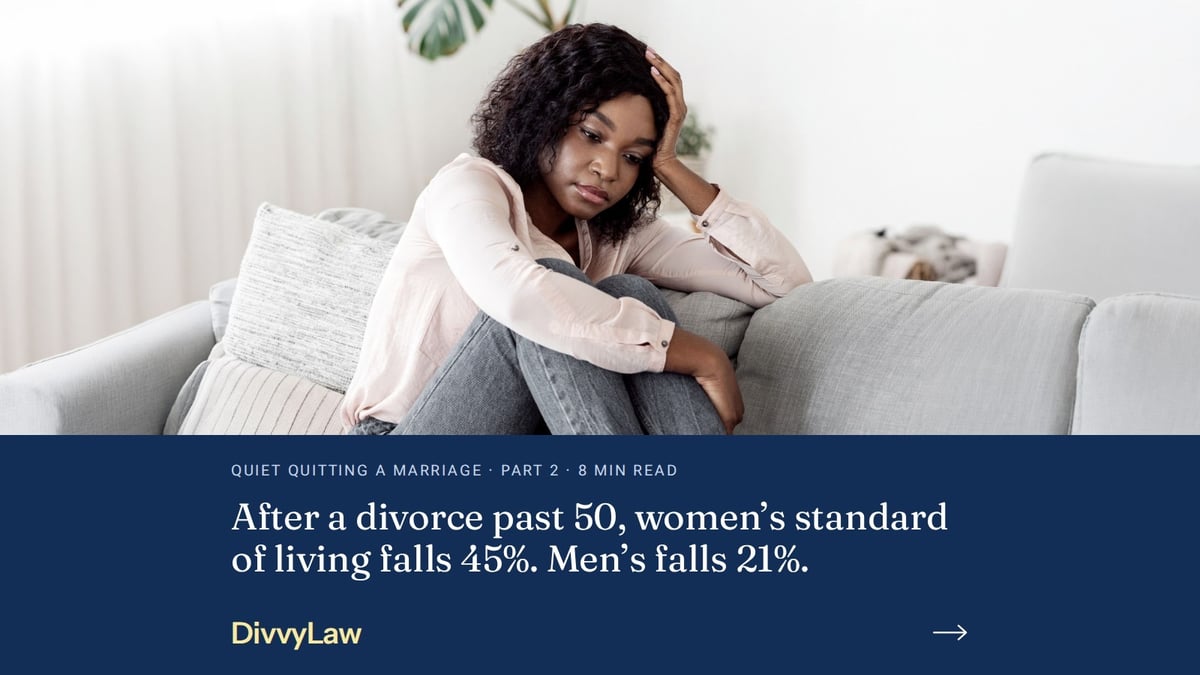
Women seem to bear the financial brunt of a divorce; The financial consequences of that later timing are not evenly distributed. In a 2021 study conducted I-Fen Lin and Susan Brown, and published in The Journals of Gerontology, they found that women who divorced after 50 had a standard of living that fell by 45 percent while men's standard of living only fell by 21 percent. In dollar terms relative to the poverty line, women's median income-to-needs ratio dropped from 3.75 to 2.07. Men went from 4.10 to 3.22. Wealth losses were roughly comparable by gender, around half, but the income shock was more than twice as severe for women. A woman who divorces at 58 has fewer years to rebuild than a woman who divorces at 42, and a labor market that is not generous to women re-entering it in their late fifties.
The fear that women feel is not irrational; it's evidence-based. But two things follow from it that cut against staying indefinitely.
The first is that waiting makes the number worse, not better. If the marriage is going to end, the financial damage is larger at 58 than at 45, and every year of the quiet quit is a year of accumulating that difference. The calculation people think they're making, that staying preserves the assets, only holds if staying is permanent. If it isn't, the delay is the expensive part.
The second is that most women in this position have never actually run the numbers. There's a difference between a financial analysis and a financial dread. The dread says it's impossible. An analysis produces a figure, and the figure is sometimes worse than expected and sometimes considerably better, and either way it's information you can act on.
The Social Security Administration, to take one concrete example, allows a divorced person who was married for at least ten years to claim benefits on an ex-spouse's earnings record starting at 62, without affecting what the ex-spouse receives. Many women who assume divorce erases their retirement have never looked that up. Whatever the answer turns out to be, it belongs in the decision, and "I can't afford it" isn't a conclusion until someone has done the work to make it one.
What acting on it looks like
None of this is an argument for divorce. It's an argument against the damage caused by the quiet quit. Where a failure to deal with an unresolved problem can turn it into a permanent condition, significantly increasing the negative impact when action is finally taken.
If a well-informed person understands the long-term ramifications and decides to continue with her quiet quit, that is a decision. Failing to price out the alternative is a default condition where she may be deceiving herself and may find that she is ultimately disappointed in the outcome. The quiet quit by design is meant to avoid that introspection.
A decision to stay that is based on an understanding of your circumstances and options is one you can ultimately live with, without remorse. Some marriages can't survive that level of insight and scrutiny.
The objection most heard to avoid opening up and discussing the reality of her marriage is that “he won't hear it," and that objection is frequently correct. Men in this situation often respond the first time badly, because they're being told that a reality they thought they understood was never the reality. But "he won't hear it" is a prediction, and it's a prediction made by someone with a strong interest in not testing it, because testing it means the end of a status quo arrangement that is exhausting and, in its way, safe.
A quiet quit is the only version of this problem in which the woman holds all the information and none of the risk of a response. Giving that up is genuinely frightening. It's also the only route to an outcome that wasn't chosen by attrition.
Beyond that, there are structured versions of the same move. Discernment counseling exists for exactly this situation: a short and deliberately limited process for couples where one person is leaning out, and the other doesn't know it yet, designed to produce clarity about direction rather than to repair anything. Couples therapy with an actual endpoint and actual criteria is a different proposition from open-ended couples therapy, which can become one more thing on the calendar that changes nothing. A financial consultation, on its own, with no decision attached, converts dread into a number.
What all these options share is a deadline and certainty. The quiet quit has none. It runs until something external forces the issue, which is why it so often ends in a filing that surprises everyone but the woman who filed it, at an age when the economics are least forgiving.
The women in Corcoran Harel's article weren't wrong about their marriages. They had accurately diagnosed that something real was wrong. Where the framing fails them is in treating the quiet quit as the resolution, when more often it's the stage where the final resolution comes at the least opportune time for the woman.
The cost of Divorce
A contested divorce in Los Angeles or Orange County can be expensive in both the outcome and the process. However, as was shared earlier, the longer a woman waits, the greater the economic impact will be. If she is forced out of the workplace by societal constraints, her ability to recover will be drastically and adversely affected.
The process of getting divorced (especially a contested divorce) can seriously reduce the assets the spouses had when the process began. Often (over eighty percent of the time), one or both parties try to navigate this very complex process alone. Trying to do it yourself without guidance can be fraught with peril. The mistakes that can be made will not only cost you time but can impact you financially for life. Some turn to Artificial Intelligence as a means of getting educated or saving costs. In our two-part series on the Hidden Costs of Using AI as Your Lawyer in an LA or OC Divorce, we shared how this method may be the most hazardous option.
There is hope and relief. We understand that the divorce process, with its unique rules and jargon, can be confusing. DivvyLaw wants to help you better understand and navigate family law issues in Los Angeles and Orange Counties.
And again: this article is general information about California law and Los Angeles County procedures, not legal advice for your situation.
We understand that the divorce process with its unique rules and jargon can be confusing. DivvyLaw wants to help you better understand and navigate family law issues in Los Angeles and Orange Counties. If you would like to be notified of upcoming blogs and added to a waitlist for access to a revolutionary solution, click the button below to join our list.
Topics: Quiet Quitting
Not legal advice
DivvyLaw is not a law firm and does not provide legal advice. DivvyLaw provides self-help software and educational materials for self-represented parties in California. Using this site does not create an attorney-client relationship. For advice about your specific situation, consult a licensed California attorney.
Keep reading
Divorce should not cost you everything
We are building DivvyLaw for Los Angeles and Orange County now. Put your name down and we will tell you the day it opens.