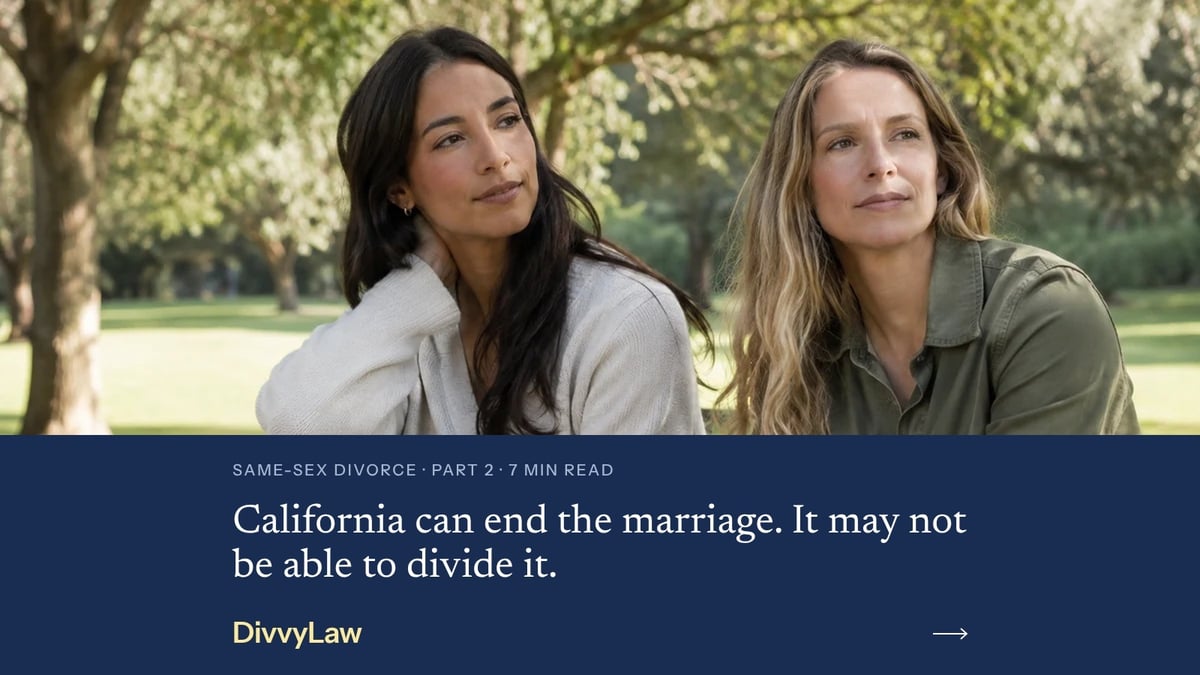
The legal landscape for same-sex marriage has seen significant changes in recent years in terms that are not favorable for same-sex couples.
This is a three-part blog series that will discuss the underlying law and how California handles same-sex divorces and how it has stepped up to protect those couples who may find themselves in a state that does not afford them the same protections. In part one of this series, we discussed what problems come up in California because the spouses are the same sex. In part three we address these issues in a Q&A format.
In this blog, we will cover what happens if you married in California but live somewhere that won't end the marriage.
Disclaimer: This blog constitutes general information and is not legal advice. This platform is not a law firm, and its employees, agents, or representatives are not acting as your attorney. The content and tools offered are intended to assist individuals in understanding and navigating the divorce process without an attorney but are not a substitute for advice from a qualified attorney licensed in your jurisdiction. To allow you to independently verify information, wherever a fact appears below, you'll find a link to the statute, court rule, or source behind it.
The Law
The Supreme Court’s 2022 decision in Dobbs v. Jackson, which overturned Roe v. Wade, sent shockwaves through the LGBTQ+ community. Justice Clarence Thomas’s concurrence specifically called for the Court to reconsider other substantive due process precedents, including Obergefell v. Hodges a decision in 2015 that legalized same-sex marriages nationwide.
This has led to renewed anxiety about the stability of marriage equality, prompting some states to repeal dormant bans and others to debate new restrictions or reaffirm traditional definitions of marriage
For same-sex couples, these legal nuances aren’t just theoretical—they have real consequences, especially when relationships end. Historically, before nationwide marriage recognition, same-sex couples who married in one state but lived in another that didn’t recognize their union faced enormous hurdles if they wanted to divorce. Many states require at least one spouse to be a resident for several months before filing for divorce, so couples sometimes had to engage in "divorce tourism," temporarily relocating just to dissolve their marriage
Today, all states must grant divorces to same-sex couples on the same terms as opposite-sex couples. But challenges remain. In states with only dormant bans and no affirmative protections, there can be confusion or resistance at the local level, and couples may worry about what would happen if federal protections were weakened.
Property division and spousal support can also be complicated for same-sex couples, especially if their relationship predated legal marriage—courts often only consider the period of legal marriage, not the full duration of the partnership, which can lead to inequitable outcomes.
Parental rights add another layer of complexity. If a same-sex couple has children—especially if only one parent is biologically related or if second-parent adoption was used—moving between states can create uncertainty. Some states may not fully recognize both parents’ rights, leading to potential custody disputes or challenges in enforcing parental rights after a divorce.
Living in a state that won't end your marriage
This is not a theoretical problem, but a valid concern based on the laws that exists in thirty states. If the Supreme Court overturns or effectively limits Obergefell v. Hodges, same-sex couples will find themselves effectively back to pre-2105 world.
Before 2015, many couples who married in California moved to or lived in states that didn't recognize same-sex marriage. Those states wouldn't grant a divorce, because in their view there was no marriage to end. The couple couldn't split property through the courts, couldn't get support orders, and couldn't legally marry someone new.
Under Obergefell, that shouldn't happen today. If you married in San Diego and now live in Texas or Florida, you file for divorce where you live and that state's law applies.
The question hasn't gone away, though. Some couples are watching the political fight over Obergefell and want to know what happens if it's overturned. Others separated years ago, never finished a divorce, and are only now sorting it out.
California's fallback: Family Code section 2320(b)
To get a divorce in California, one spouse usually has to have lived in the state for six months and in the county for three months before filing. Section 2320(b) makes an exception for same-sex marriages.
A California court can grant a divorce, annulment, or legal separation even when neither spouse lives here, if the couple married in California and neither spouse lives in a place that will dissolve the marriage. If the state where they live don’t recognize the marriage, the law presumes that state won't end it either.
The case is filed in the county where the couple married, and California law decides it. A couple who married in Long Beach and later moved away would file in Los Angeles County Superior Court.
Registered domestic partners have an even broader option. Family Code section 299 allows a partnership registered in California to be dissolved in a California court "even if neither domestic partner is a resident of, or maintains a domicile in, the state."
As long as Obergefell stands, section 2320(b) will rarely comes into play. If the Supreme Court ever reversed course, it would matter again almost immediately. So would the Respect for Marriage Act. Because that law requires states to honor marriages validly performed elsewhere, a couple married in California would have a strong argument that their home state still has to treat the marriage as real, including when it's time to end it. No court has had to decide that question yet.
What a California court can and can't do for spouses who live elsewhere
Ending the marriage itself is the simplest piece. Support, property, and custody each come with limits.
A court can't order someone to pay support unless it has personal jurisdiction over that person. In Kulko v. Superior Court (1978), the U.S. Supreme Court ruled that California couldn't order a New York father to pay child support simply because his children had moved to California to live with their mother. If your spouse lives in another state and has no real connection to California, a judge here may be able to end the marriage without being able to order support. A spouse who takes part in the case, which is common in uncontested divorces, generally gives the court that authority.
Custody is decided by a different set of rules. Under the Uniform Child Custody Jurisdiction and Enforcement Act, which California has adopted, the court with authority to make the first custody order is usually in the child's "home state," meaning where the child has lived for the six months before the case is filed. If your children live in Arizona, an Arizona judge will likely decide custody even if a California court ends the marriage.
This is one more reason to have a parentage judgment or adoption in hand. A parent who shows up to a custody case in another state with a California court order is in a far stronger position than one relying on a presumption.
If you just moved to California
Newcomers to Los Angeles or Orange County who haven't hit the six-month mark don't have to wait to get started. Fam. Code § 2321 provides that a legal separation only requires that one spouse live in California, with no minimum period. Once the residency requirement is met, either spouse can amend the petition to ask for a divorce, and the amended filing date becomes the date the divorce case started.
Summary
While marriage equality is the law of the land, but the uneven patchwork of state laws—combined with ongoing political and legal uncertainty—means same-sex couples, particularly those divorcing or relocating, should stay informed about the laws in their specific state.
Our final blog in this series will be to provide options that are available to same-sex couples.
And again: this article is general information about California law and Los Angeles County procedure, not legal advice for your situation.
We understand that the divorce process with its unique rules and jargon can be confusing. DivvyLaw wants to be a conduit to allow you to better understand and navigate family law issues in Los Angeles and Orange Counties. If you would like to be notified of upcoming blogs and be put on a weight list for access to a revolutionary solution, click on the link below and you will be added to our list.