Prenups are no longer just for the wealthy. Individuals seem to be marrying much later in life than they did thirty years ago. Some sociologists claim this is due to increased life expectancy, while others say many individuals want an established career before they get married. In any event, by the time they seek to marry, many individuals have often accumulated a significant amount of assets or debt.
It is not that unusual for a person to have their own business, hold real estate, or have retirement accounts by the time they seek to tie the knot.
Whether you have a lot of assets or significant student loan debt, a prenuptial agreement can provide you with financial clarity and protections going into your marriage.
In part one of this blog series, we discussed what a prenuptial agreement can contain and what the requirements are to ensure your prenup does not get thrown out by the court when you are in a divorce proceeding.
In this second blog of the series, we will discuss the mechanics that evolve when a prenup is part of a divorce proceeding in both Los Angeles and Orange County
Disclaimer: This blog constitutes general information and is not legal advice. This platform is not a law firm, and its employees, agents, or representatives are not acting as your attorney. The content and tools offered are intended to assist individuals in understanding and navigating the divorce process without an attorney but are not a substitute for advice from a qualified attorney licensed in your jurisdiction. To allow you to independently verify information, wherever a fact appears below, you'll find a link to the statute, court rule, or source behind it.
The Expectation - the Agreement Holds
Two paths may occur when a prenuptial agreement is involved in a divorce proceeding. If the prenuptial is deemed invalid, the matters otherwise covered by the agreement become part of what can become a long and expensive litigation where one party may have a lot to lose.
California community property laws then dictate that what the couple owns or owes together during marriage is divided equally. While each spouse keeps their separate property, which is what each owned or owed before marriage, if during the marriage money went to improve or pay a mortgage, that difference can also be considered community property. Each party keeps assets acquired after the date of separation, plus gifts and inheritances received at any time. Anything acquired while living outside California is quasi-community property and gets treated like community property.
The valuation of assets or when the parties actually separated can become highly litigated issues.
A valid prenup replaces all of that with whatever the parties agreed to when they had better intentions with each other. In practice, it eliminates characterization arguments, tracing exercises, and most of the expert work. A case that would have needed a forensic accountant to untangle commingled accounts becomes a drafting exercise.
What it doesn't eliminate is worth listing, because clients consistently expect otherwise.
Financial disclosure still happens. Sharing financial information is a required step in every divorce or legal separation. The petitioner's preliminary disclosure is due within 60 days of filing the Petition and the respondent's within 60 days of filing the Response. The disclosure waiver in section 1615 is premarital, and it does nothing for the dissolution-stage obligation. Hide assets at this stage, and the judge can award property to your spouse or order you to pay their attorney's fees.
The six months still runs. The earliest a divorce can be final is six months from the day the other spouse was served or responded, whichever comes first. Orange County states the rule the same way and adds that no divorce is final until a Judgment of Dissolution is signed by a judge, which one of the parties has to prepare and submit. A prenup that resolves every financial issue on day one buys you nothing on the calendar.
The mechanics diverge sharply between the two counties
Los Angeles is geographic. The Superior Court operates 36 courthouses across twelve districts, and your case belongs in the district courthouse rather than the one closest to you. [13] Orange County is the opposite: all family law documents relating to dissolution, legal separation, and nullity must be filed at the Lamoreaux Justice Center only, at 341 The City Drive South in Orange. [17] One county, one family law filing counter.
Orange County also has residency and paperwork wrinkles worth knowing. A party must have lived in California for six months and in Orange County for the three months immediately preceding the filing of the Petition. [17] The initial packet includes a local form, the Family Law Declaration Regarding Related Cases (L1120), alongside the FL-100 and FL-110. [17] And attorneys don't have a choice about filing method: under Code of Civil Procedure section 1010.6, California Rule of Court 2.253(b)(2) and Orange County Local Rule 700.7, documents filed by attorneys in family law cases must be filed electronically unless the court excuses them, with self-represented parties exempt but encouraged to participate. That mandate was expanded to cover ex parte filings effective January 2, 2024. [18]
For couples whose prenup resolves everything, Orange County offers two shortened tracks. Summary dissolution is available to couples married less than five years with no children, little property and little debt. [17] Couples who don't qualify can file a Joint Petition and Joint
How a Disputed Prenuptial Agreement Is Handled in Los Angeles and Orange County
A challenged prenup doesn't get resolved alongside everything else. It gets tried and usually tried first. The reason the validity of the prenup is tried and determined first is that if the agreement stands, everything downstream collapses into a drafting exercise. If it falls, you're doing a full community property trial with tracing, valuation dates, and experts. Nobody wants to prepare both cases at once, so the validity question goes first.
When a spouse disputes a prenuptial agreement during divorce, California Family Code § 1615 governs the challenge in both counties — the substantive law is identical statewide. What differs is the procedural pathway, court structure, and local case management practices that shape how the dispute moves through the system
One major difference is a geographic one. In Los Angeles County, there are twelve courts that handle family law cases. The determination of which courthouse will handle your case is based on both the city/zip code of the petitioner and the court docket. So the fact that your address falls within a particular district’s geographic boundaries does not necessarily mean your case will be assigned to that district.
In Orange County, all divorces are handled at the Lamoreaux Justice Center.
To properly file this, you need to:
To properly complete this request in California, you must bundle the following documents together:
- Form FL-300 (Request for Order): This is the master motion form. You must check the box for "Other" on page 1 and write in "Bifurcation of Validity of Premarital Agreement".
- Form FL-315 (Request or Response to Request for Separate Trial): You must check the box next to "Validity of a premarital or postnuptial agreement" and physically clip/attach this behind your FL-300.
- Supporting Declaration: Under Item 10 of Form FL-300 (or on a separate Form MC-030 Declaration), you must write a factual statement explaining why a separate trial is necessary and how deciding the prenup's validity early will save the court time or simplify asset division.
- Preliminary Financial Disclosures: Under California family law, you generally must complete and serve your Preliminary Declaration of Disclosure (Form FL-140), along with your schedule of assets/debts and income declarations (Form FL-150) before or alongside your request for a separate trial.
Criteria for Validity and Fairness of Prenuptial Agreements in California
That trial is about more than the contract language. It's also about the transaction, and the transaction may have happened twenty years ago
California courts apply a two-part test under Family Code § 1615 to determine whether a prenuptial agreement is enforceable:
- whether it was executed voluntarily, and
- whether it was unconscionable when executed.
The party seeking to enforce the prenup bears the burden of proving voluntariness by clear and convincing evidence, while the party challenging it must prove unconscionability.
The Voluntariness Test: Five Mandatory Findings
Under Family Code § 1615(c), a prenup is presumed unenforceable unless the court makes written or on-the-record findings on all five of the following elements:
- Independent legal counsel or written waiver — The party against whom enforcement is sought was represented by independent counsel at signing, or was advised to seek counsel and expressly waived that right in a separate written instrument.
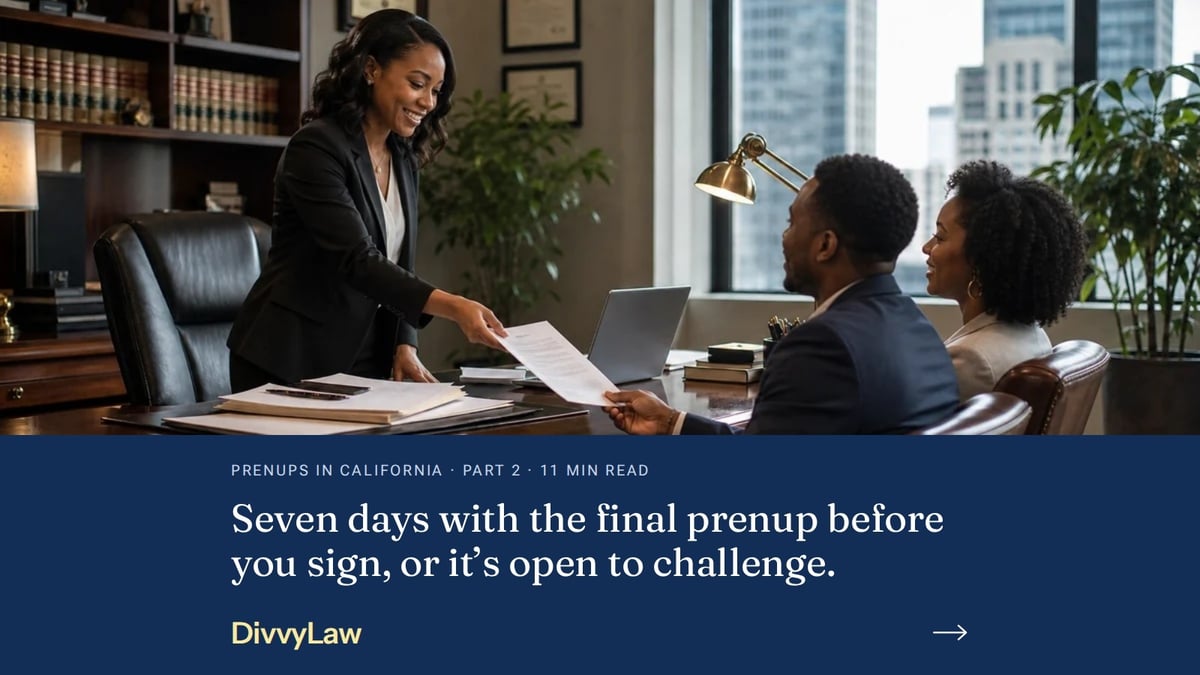
- Seven-day waiting period — At least seven calendar days elapsed between the time the party was first presented with the final agreement and advised to seek counsel, and the time the agreement was signed. For agreements executed on or after January 1, 2020, this seven-day rule applies uniformly.
- Full informed understanding (if unrepresented) — If the party was not represented by counsel, they were fully informed of the terms and basic effect of the agreement, the rights and obligations they were giving up, and were proficient in the language in which the explanation was conducted and in which the agreement was written.
- No duress, fraud, or undue influence — The agreement and related waiver writings were not executed under duress, fraud, or undue influence, and the parties had legal capacity to enter the agreement.
- Catch-all provision — Any other factors the court deems relevant.
The Unconscionability Test: Two-Prong Analysis
A prenup can also be invalidated if the challenging party proves it was unconscionable when executed and all three of the following disclosure failures occurred:
- The challenging party was not provided a fair, reasonable, and full disclosure of the other party’s property or financial obligations.
- The challenging party did not voluntarily and expressly waive, in writing, the right to disclosure beyond what was provided.
- The challenging party did not have, or reasonably could not have had, adequate knowledge of the other party’s property or financial obligations.
California courts evaluate unconscionability using two distinct dimensions:
- Procedural unconscionability - Whether the process was fair — oppression from unequal bargaining power, surprise from hidden or unexpected provisions, timing pressure
- Substantive unconscionability - Whether the terms are one-sided and unreasonable, lacking justification — assessed at the time of signing, not enforcement
It is important to note that spousal support waivers are afforded scrutiny than property division terms. Under Family Code § 1612(c), a spousal support waiver or limitation is enforceable only if:
- Both parties were represented by independent counsel at the time of execution — this is mandatory, not waivable.
- The waiver is not unconscionable at the time of enforcement — this is a separate, forward-looking test distinct from the at-execution standard.
For the enforcement-time unconscionability analysis of spousal support waivers, the court considers:
- Whether more than ten years have passed since execution
- Whether a child was born or adopted by the parties
- Whether there has been a material change in circumstances affecting the supported party’s ability to support themselves
- The outcome if the waiver is enforced versus the outcome without it
If the waiver falls, the judge doesn't invent a number. The court applies the Family Code section 4320, where the court shall consider all the following factors:
(a) The extent to which the earning capacity of each party is sufficient to maintain the standard of living established during the marriage, taking into account all of the following:
(1) The marketable skills of the supported party; the job market for those skills; the time and expenses required for the supported party to acquire the appropriate education or training to develop those skills; and the possible need for retraining or education to acquire other, more marketable skills or employment.
(2) The extent to which the supported party's present or future earning capacity is impaired by periods of unemployment that were incurred during the marriage to permit the supported party to devote time to domestic duties.
(b) The extent to which the supported party contributed to the attainment of an education, training, a career position, or a license by the supporting party.
(c) The ability of the supporting party to pay spousal support, taking into account the supporting party's earning capacity, earned and unearned income, assets, and standard of living.
(d) The needs of each party based on the standard of living established during the marriage.
(e) The obligations and assets, including the separate property, of each party.
(f) The duration of the marriage.
(g) The ability of the supported party to engage in gainful employment without unduly interfering with the interests of dependent children in the custody of the party.
(h) The age and health of the parties.
Custody stays outside the agreement in both counties
No matter what the prenup says, custody and child support run on their own track. Child support cannot be adversely affected by a premarital agreement. Custody disputes go through mediation before a judge hears them. Mediation covers legal custody, physical custody, and visitation only. Child support, spousal support, and evidence against the other parent are excluded and go to the judge.
This process will be discussed in a separate blog article.
Summary:
Prenuptial agreements, if prepared properly and in accordance with Family Code Sections 1610–1617, can streamline the process and make a divorce less contentious. If you have failed to meet the standards and conditions of this law, the reality is that all the planning was for naught.
Again: this article provides general information about California law and Los Angeles County procedure, not legal advice for your situation.
We understand that the divorce process with its unique rules and jargon can be confusing. DivvyLaw wants to help you better understand and navigate family law issues in Los Angeles and Orange Counties. If you would like to be notified of upcoming blogs and added to a waitlist for access to a revolutionary solution, click the button below to join our list.
.png?width=900&height=246&name=divvy-logo-blue-rgb-900px-w-72ppi%20(1).png "DivvyLaw")