If you live in Los Angeles or Orange County, California, and are considering a divorce, you will quickly face the realization that a divorce is not cheap. We are not referring to life-changing issues of dividing assets, spousal and child support. We are talking about how expensive it can be to hire an attorney to help you through the process. This is especially true when the divorce is a contested one.
Imagine this all too real scenario: It's 2 a.m., you can't sleep, and the divorce papers are sitting on the kitchen counter. A lawyer wants a $7,500 to $15,000 retainer just to get started, and hourly rates in Los Angeles commonly run $350 to $650. You can’t imagine how you will be able to afford those costs and still live. Then you remember, you have the knowledge of all mankind sitting right on your laptop. ChatGPT is free, it's awake, and it answers every question in confident, polished paragraphs. So, you start typing. What could go wrong?
Millions of people face this exact scenario. The information being shared by ChatGPT or any of the many artificial intelligence platforms looks professional and sounds lawyerlike. However, the fallacy of that belief does not show up in the chat window. They show up months later, in a courtroom in Santa Ana or downtown Los Angeles, when a judge asks you about where a case citation came from, or when your spouse's attorney serves a subpoena for records you assumed were private, or when you discover the "settlement advice" you followed gave away a pension share worth six figures.
This is a two-part blog series. In part one, we will lay out the risks in detail. In the second blog, we will discuss why AI gets it wrong so often and what the better alternative is if you want to DIY and save tens of thousands of dollars. We separated this blog into two parts because we really want you to focus on the ramifications that using AI can have and how it can destroy your credibility and case.
The uncomfortable part that should get your attention before anything else: it is not a question of being smart enough to figure out what you should or shouldn’t use. The people getting burned by AI in court aren't just anxious spouses typing questions at midnight. They include licensed attorneys at big firms, with decades of experience. If AI is tripping up the professionals, it's worth asking what it will do to someone facing the most consequential legal proceeding of their life without any legal training at all.
Start With the Lawyers Who Got Caught
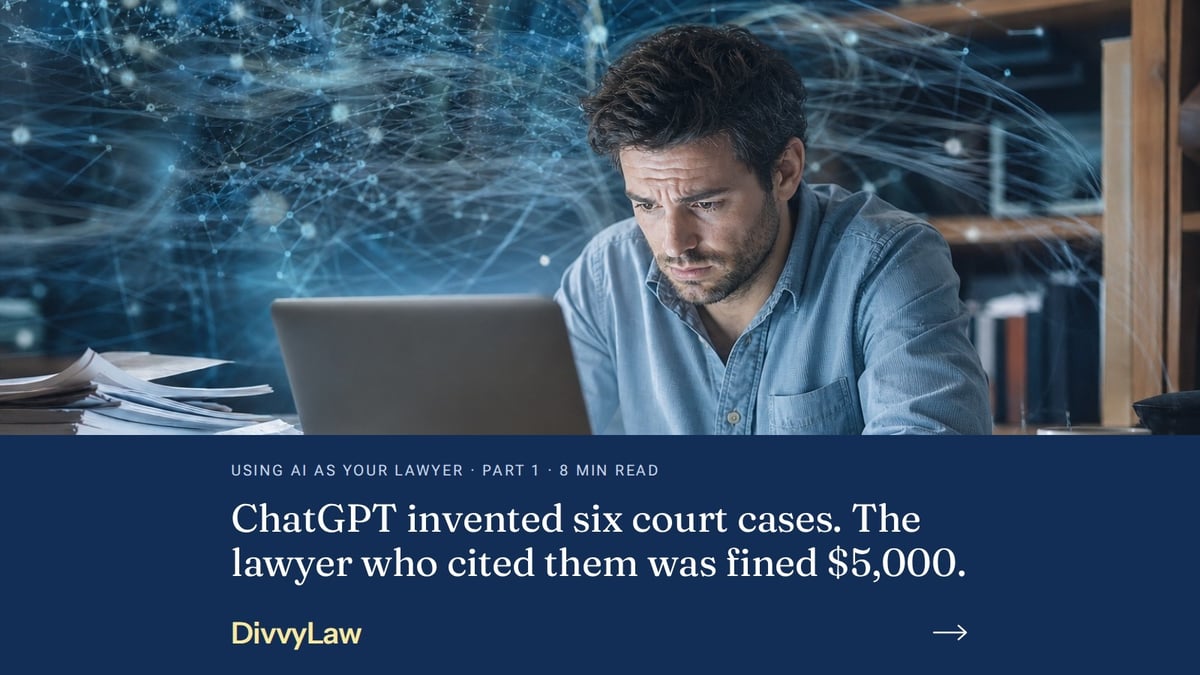
The first famous casualty was a New York personal injury lawyer named Steven Schwartz. In 2023, in a case called Mata v. Avianca, Schwartz used ChatGPT to research a brief and filed it with six case citations supporting his argument. None of the six cases existed. ChatGPT had invented them, complete with realistic-sounding names, docket numbers, and quotes. When opposing counsel and the judge couldn't find the cases, Schwartz went back to ChatGPT and asked if the cases were real. It assured him they were. The court fined Schwartz, his co-counsel, and their firm $5,000 and ordered them to send letters to every real judge falsely named as an author of the fake opinions. The story ran in national newspapers with his name attached, which is a penalty no fine can match.
You might expect the profession to have learned its lesson. It didn't, and California produced two of the most instructive follow-ups.
In September 2025, a California Court of Appeal issued the state's first published opinion on AI-fabricated citations, Noland v. Land of the Free, L.P. The plaintiff's attorney had used generative AI to draft his appellate briefs without verifying what it produced. Of the 23 case quotations in his opening brief, 21 were fabricated. Entire passages were attributed to published opinions that said no such thing; some of the cited cases didn't exist at all. The court sanctioned the attorney $10,000, ordered him to send the opinion to his own client, and referred him to the State Bar of California for possible discipline.
A few months earlier and a few miles away, in federal court in Los Angeles, two large law firms learned the same lesson at triple the price. In Lacey v. State Farm, a judge in the Central District of California sanctioned the firms $31,000 after they filed a brief with AI-generated citation errors, failed to disclose the AI use, and then refiled a "corrected" version that contained new inaccuracies. The judge called the conduct reckless and the filings misleading.
These aren't isolated embarrassments. A researcher named Damien Charlotin maintains a public database of court decisions involving AI-hallucinated citations, and by mid-2026 it had documented well over a thousand cases worldwide, with more than a thousand in the United States alone. The tracker grew so fast that Forbes covered it as an essential tool for attorneys.
If trained lawyers, who know how to research cases and who have access to such real legal databases as Westlaw and LexisNexis, have failed so miserably using AI, what chance do you have to get it right? Are you willing to risk your financial future or custody of your children on a hope that you will not be misled?
The Courts Will Not Save You
California family law courts are considered courts of equity, which have flexibility to fashion appropriate equitable remedies to achieve fairness. However, this does not mean that the Court will give you slack if you use fantasy citations or fail to file on time due to bad AI advice. The Court is also not allowed to tell you what you should be doing.
Pro se litigants (individuals representing themselves) typically commit more fundamental mistakes, such as citing completely fabricated cases, copying and pasting legal arguments without verification, or misunderstanding basic procedural requirements because they trusted AI suggestions.
These errors often appear across multiple rounds of amendments and rarely self-correct before court intervention. In 2025, pro se litigants (those representing themselves) accounted for 39% more hallucination-related incidents than attorneys, highlighting the heightened risk for self-represented parties
Family law judges in Los Angeles and Orange County see thousands of self-represented parties, and most judges are patient with honest confusion about procedure. What they are not patient with is a brief or declaration quoting cases that don't exist, because at that point you haven't made a mistake; you've put false information in front of a court, signed under penalty of perjury. Judges have responded with fines, community service, and dismissed filings. And in a divorce, there's a subtler penalty that never appears in a sanctions order: the judge who caught you filing fiction now doubts everything else you say, including your testimony about income, assets, and parenting. Credibility is the currency of family court, and it doesn't come back once you spend it.
Your Chats Are Not Private, and Your Spouse's Lawyer Knows It
This risk deserves more attention than it gets, because it turns the tool against you.
Unlike communications with an attorney, communications with public AI tools are not protected by attorney-client privilege. Anything you share with an AI chatbot—such as financial records, legal strategy, or sensitive family details—can potentially be subpoenaed and used as evidence against you
This loss of confidentiality can have devastating consequences in contentious family law disputes.
Now think about what's actually in your chat history. "How do I keep my spouse from finding my crypto account?" "Can I move money before filing?" "What happens if I underreport my bonus?" People type things into a chatbot they would never say out loud, on the theory that it's a private notebook. In litigation, it's better understood as a diary that can be subpoenaed. Divorce discovery is invasive by design; each side can demand documents, records, and electronically stored information. A chat log in which you brainstormed ways to hide assets isn't just embarrassing. In a state where your financial disclosures are signed under penalty of perjury, it's evidence.
The professionals treat this danger seriously. The State Bar of California's Practical Guidance for the Use of Generative Artificial Intelligence in the Practice of Law, approved in November 2023, tells attorneys not to put confidential client information into consumer AI tools unless they're certain the provider won't share or train on it. Lawyers, with their duty of confidentiality on the line, are warned off typing their secrets into ChatGPT. You'd be typing them in yourself, about yourself, with no duty protecting you at all.
Artificial Intelligence is Not Real Intelligence
The bottom line is don’t be seduced by the lure of artificial intelligence. While each generation provides enhanced skills, the way they collect and use their “logic” is distorted at best. Our next blog will share why this is the case and finally answer: what are my alternatives to an unbearable legal expense?
One final disclosure, in the spirit of the disclosures this article keeps recommending: this piece is general information, not legal advice, and no article can account for the facts of your case. Verify anything here that matters to you against the linked sources, and before you make decisions in your divorce. That advice would hold even if this article were wrong about everything else, which is precisely the point.
We understand that the divorce process with its unique rules and jargon can be confusing. DivvyLaw wants to help you better understand and navigate family law issues in Los Angeles and Orange Counties. If you would like to be notified of upcoming blogs and added to a waitlist for access to a revolutionary solution, click the link below to join our list.
.png?width=900&height=246&name=divvy-logo-blue-rgb-900px-w-72ppi%20(1).png "DivvyLaw")