For every parent, child custody is one of their biggest fears when going through a divorce. The thought that some stranger will decide who gets to make decisions about how to raise their child or even where they will live after a divorce is both heart wrenching and fraught with anxiety. While the world may see a judge as an impartial person, a parent only sees a person who could not possibly understand the family dynamics or what the child really needs.
In California the core legal principle that determines child custody is the "best interest of the child" standard. Courts evaluate the child's health, safety, and welfare, each parent's history of caregiving, any history of abuse or substance use, and how well parents can cooperate to share frequent and continuing contact with both sides. While this standard should give a parent a bit of comfort, it is still a third-party who has very little time or contact making a decision that will impact the family for years to come.
However, while the best interest of the child will always be the overarching standard that courts will follow, California has built into the law a mechanism that hands back to the parents the opportunity to craft what this will look like for the child.
In California, child custody mediation is mandatory whenever custody or visitation is contested. This article will look at how the process plays out in both Los Angeles and Orange County. To make this information more digestible we will present this in a Q & A format.
This is the third article in our five-part series on how mediation impacts divorce proceedings in Los Angeles and Orange County. We have structured our examination of this process to allow you to not only understand the mechanics, but also understand how to position yourself to achieve the maximum benefits.
Disclaimer: This blog constitutes general information and is not legal advice. This platform is not a law firm, and its employees, agents, or representatives are not acting as your attorney. The content and tools offered are intended to assist individuals in understanding and navigating the divorce process without an attorney but are not a substitute for advice from a qualified attorney licensed in your jurisdiction. To allow you to independently verify information, wherever a fact appears below, you'll find a link to the statute, court rule, or source behind it.
What is Child Custody court ordered mediation?
In California, court-ordered mediation in a divorce applies strictly to child custody and visitation disputes, requiring parents to meet with a professional before a judge will hear a contested custody case.
Unlike private mediation for other marital matters, child custody mediation is a mandatory process you cannot decline. Family Code section 3170 says that when custody or visitation is contested, "the court shall set the contested issues for mediation," and in both Los Angeles and Orange County that appointment sits between you and a hearing date. Los Angeles Superior Court is explicit that even parents who reach a partial agreement through the court's online dispute resolution program still have to attend, stating that mediation "is still mandatory."
What is the process for a court ordered family law mediation?
Filing and Referral: In family law cases involving child custody, California law requires mediation before a judge will hear the dispute. The court clerk schedules or refers the case to mediation upon the filing of initial custody or visitation papers.
- Los Angeles County: the parties request a Family Court Services appointment and confirm it by submitting the Family Court Services Confidential Mediation Form, available in English and Spanish. Appointments are conducted by video-conference or telephone, with video participants receiving an emailed invitation and link. The Family Court Services mediation office can be reached at 213-830-0835.
- Orange County: Family Court Services appointments are conducted remotely by Zoom by default, intake forms must be completed in advance, and the department can be reached at 657-622-6196. Orange County's fee structure varies by service, with some services free and certain investigations requiring payment.
What to expect in a court ordered family law mediation?
A court ordered family law mediation is a more formal process that private mediation.
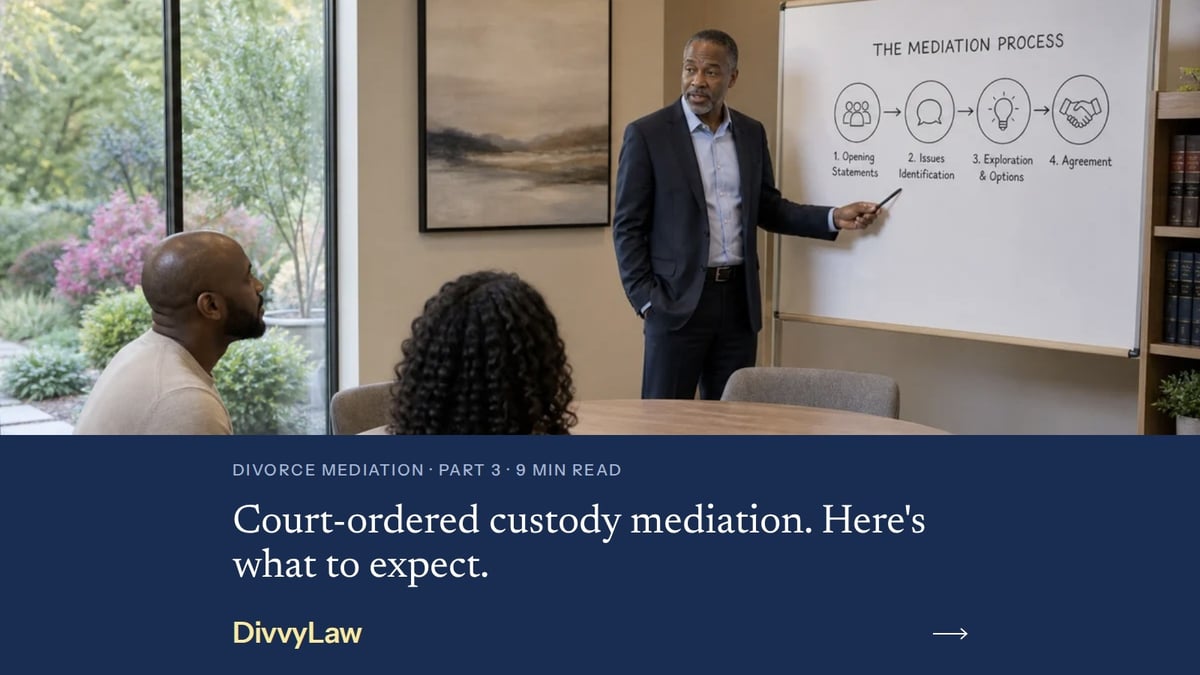
Commencement - The mediator explains the role, explains confidentiality, and explains what happens to anything you say. In Los Angeles and Orange County court mediation, what you say stays in the room: Family Code section 3177 requires that these proceedings be held in private and be confidential, and treats communications from the parties to the mediator as official information under Evidence Code section 1040. Evidence Code section 1121 separately bars any mediator report, assessment, evaluation, recommendation, or finding from reaching the court, other than a report stating only whether an agreement was reached.
Agenda-setting, a mediator will typically suggest a sequence for dealing with the issues before them in order to optimize the possibility of an agreed upon outcome. Often they will start with the areas less problematic and something you're close to agreeing on to build a small amount of trust that the next question can draw on. A good mediator will suggest a sequence. You can push back on it.
Middle of a session is mostly information and arithmetic. What's the house worth? What's the mortgage balance? What did the 401(k) hold at the date of marriage? What does the child support guideline produce at a 60/40 timeshare versus 50/50? Couples who arrive without these numbers spend their session generating them.
The Conclusion - The culmination of a productive session is a written summary. Sometimes that's a full marital settlement agreement. More often it's a term sheet or memorandum of understanding capturing what was agreed, with open items flagged.
Will a court ordered mediator decide our issues?
No, a court order mediator doesn't decide anything. They will suggest, cajole and try to motivate you to an agreement, but it is incumbent on the two parties to reach an agreement.
Are there any protections if a party is afraid of their spouse?
Yes, in court ordered mediation where there's a history of domestic violence or a protective order, Family Code section 3181 provides: where there has been a history of domestic violence between the parties or where a protective order as defined in Section 6218 is in effect, at the request of the party alleging domestic violence in a written declaration under penalty of perjury or protected by the order, the mediator appointed pursuant to this chapter shall meet with the parties separately and at separate times.
If domestic violence is an issue, it is important that you communicate this to the mediator.
What happens in a court ordered family law child custody mediation in California does not reach an agreement?
If you do not reach an agreement in a court-ordered child custody mediation in California, your case proceeds to a judge or hearing officer who will make the custody and visitation decisions for you.
For non-recommending counties such as Los Angeles or Orange:
- Confidential Process: The session is completely confidential.
- No Report to the Judge: The mediator only reports to the court that the parties attended, but they cannot tell the judge what was said or make any custody recommendations.
- Moving to a Hearing: You and the other parent will proceed to a scheduled court hearing where you can present evidence, testify, and let the judge decide your custody arrangements.
What happens if a court-ordered family law child custody mediation in California only reaches a partial agreement or no agreement at all?
In California court-ordered child custody mediation, reaching a partial agreement means the court adopts your agreed-upon terms, and a judge decides the remaining unresolved issues at a hearing. If there has been no agreement, then the judge decides everything.
What Happens to the Partial Agreement or no agreement
- Drafting the Plan: The mediator writes down the specific points where both parents successfully agreed (for example, sharing joint legal custody).
- Court Approval: The partial agreement is submitted to the judge to be signed and turned into a partial court order.
What happens after that not only depends on the county but on the courthouse in which your case is being heard. If your case is handled in Orange County or under the traditional LA County model (used by most Los Angeles county courthouses) the mediation is completely confidential.
- For the Agreed-Upon Items: The mediator writes down the partial agreement, both parents sign it, and it goes to the judge to become a court order.
- For the Disputed Items: The mediator does not give the judge a report, opinion, or recommendation. They simply check a box notifying the court that a partial agreement was reached and that other issues remain unresolved.
- The Court Hearing: Because the judge receives zero information or input from the mediator about the remaining disputes, it is entirely up to you (and your attorney, if you have one) to present evidence and argue your side from scratch at the hearing.
There is a Pilot Program (Stanley Mosk Courthouse)
If you have a contested dissolution (divorce) case at the Stanley Mosk Courthouse in downtown Los Angeles, your case may fall under a pilot program (General Order 2026-GEN-011-00).
- Under this program, if your initial mediation session only results in a partial agreement, a second session called Child Custody Recommending Counseling (CCRC) is triggered.
- In this second session, the specialist will write a formal recommendation for the judge detailing how they believe the unresolved disputes should be settled. You and your attorney will receive a copy of this recommendation before you go in front of the judge.
Child custody and visitation decisions will always be one of the most highly contentious aspects of any divorce. Most parents cannot envision any outcome as being positive where their child is not under their care one hundred percent of the time. While it is very difficult for either parent to bend and accept the new reality, if they can utilize the mediation process to craft a version that while not perfect works them, they can avoid having a stranger make those decisions.
Part four of this blog series is about the preparation that makes the difference in your mediation outcome. We will discuss how to make the mediation process productive and work for you.
And again: this article is general information about California law and Los Angeles and Orange Counties, it is not legal advice for your situation.
We understand that the divorce process with its unique rules and jargon can be confusing. DivvyLaw wants to be a conduit to allow you to better understand and navigate family law issues in Los Angeles and Orange Counties. If you would like to be notified of upcoming blogs and be put on a wait list for access to a revolutionary solution, click on the link below and you will be added to our list.